I attended a test ride event last week in Palo Alto, at the ALSO HQ. They had a handful of bikes, configured in a variety of ways—with the standard or cargo seat, one with the front rack, etc. They didn’t have any set up in the trail-ready trim, nor did I see a launch edition model.
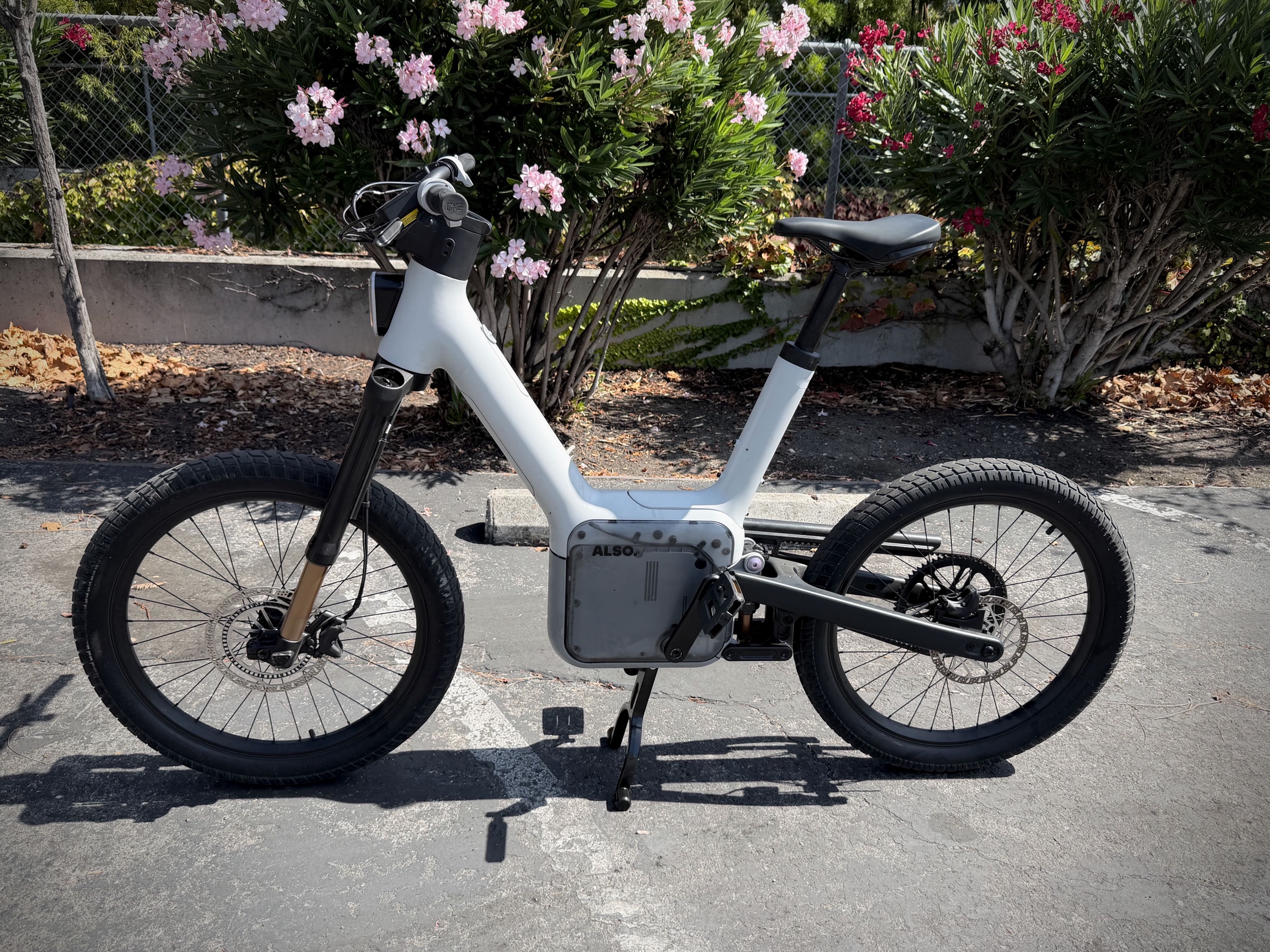
The ride was interesting. The most obvious difference from other e-bikes I’ve ridden is the pedal-by-wire system. That is, there is no physical connection between the pedals and the drivetrain; a computer translates your pedaling into power at the wheel. This allows it to provide a friendly, shifting-free experience that is very approachable.
Front and rear suspension are standard, and I noticed it working over bumps and road imperfections. The riding position is upright and comfortable, and the pedals are placed in a good position for me. The disc brakes are effective enough, but not particularly a strong point. They squealed when really applied hard, but that’s surely just a setup issue on this particular bike. I’d like to see stronger brakes, but I’m used to powerful MTB disc brakes, and I’m sure these are serviceable enough for the intended purpose. The saddle is also pretty comfortable.
The TM-B has 24-inch wheels front and rear, with large, thick tires. (I rode a model with standard road tires, not the knobby trail tires on some specs.) The tires are tubed, and the rims are not tubeless-ready—a rather large disadvantage in my mind. I can imagine that the average customer might not be versed (or interested) in tubeless tire maintenance, but the protection tubeless tires provide is a big win in my book, and I’d want my tires to be set up that way. In any case, the large volume of the tires made for a comfortable ride, and they provided plenty of traction on the road, even under heavy braking.
The weight of the bike is probably its biggest detriment, especially for a commuting use case. I could lift it, but wouldn’t want to have to move it very far that way. I certainly wouldn’t want to have to lift it up a flight of stairs, which is a fairly common situation at train stations where I live. Like a lot of e-bikes, it has a “walk mode”, where it can assist in rolling itself while you walk the bike. The ALSO representative said they’re working on software-based solutions to climbing stairs, although he did not tell me what form that would take.
The battery is physically smaller than I expected it to be, and I’m still pleasantly surprised at the claimed range and recharge time (over USB-C!) that it provides. I guess that Rivian DNA really paid off in this area.
Software and Controls
The software in general seemed very strong. It was well-designed, and the controls thoughtful. The phone integration seemed solid, and the reps were bullish on the future updates that would come to the bikes. The controls are very beginner friendly, with easy to adjust physical knobs and buttons. In particular, a ring around the right handlebar, next to the grip, adjusts the assistance level, and a large button that reminded me of a large dropper post lever allows quick access to more power/assistance for as long as it’s pressed.
The TM-B has turn signals, which surprised me a bit. This is one place where the controls weren’t great: I found the switches for the signals to be unintuitive, though workable after playing with them a bit. I was also surprised that they didn’t stop indicating a turn after either a turn or a period of time; I found myself riding for a bit with a turn signal blinking before noticing it. The indicator on the main display was also subtle enough that it didn’t attract my attention, and there was no noise made to warn me it was still on. I think even a audible alert that increased after a few seconds could be enough. I’ve had a motorcycle with automatically cancelling signals, and this feels like a place where ALSO could improve. The rep indicated they were working on something in this area.
I rode during the day, so I didn’t really test the lighting, but it seemed solid. Having integrated lighting front and rear is super welcome here, and it looked really nice.
The center-mounted kickstand was easy to deploy and stow, and held the bike steadily. One glaring omission for a bike like this is the lack of built-in fenders. I really appreciate them on my Brompton, even though I’m pretty much a fair-weather bike commuter.
Security
I like that the whole thing is built to be theft-resistant. This is one place where its weight is a benefit—it’s not easy to pick up casually and run off with. When you walk away from the parked bike (based on your phone), its wheels lock in place, and an alarm sounds if the bike is tampered with. It has multiple antennas and a cell connection, and it notifies you if the alarm is triggered. The battery locks in place so that it can’t be removed, too. The removable components like the battery are electronically keyed to the bike, so even if the bike was stolen and stripped, the parts won’t work on other bikes. It automatically unlocks when you return. Overall, this seemed to be a really thoughtful part of the bike.
One negative in the security area is that the bike doesn’t have any kind of integrated cable lock or other physical way to lock it to a rack. The rep said he uses a U-lock to protect his when he leaves it someplace, and carries it on the rack. I’d have liked to see a built-in solution to this, as many of the commercial e-bikes have. Locks aren’t a big barrier to real thieves, but they are another layer against the bike being casually stolen. Besides, the frame is not a standard triangle, and it’s thick, so I’m not even sure how big a U-lock one would need for it. At the least, I’d hope for a first-party lock storage solution or attachment method for a physical lock.
Off-Road/Trail Mode
As readers of this blog know, I’ve been concerned about the marketing of this bike showing it on trails, when it’s clearly a Class III e-bike, and those are almost never allowed on trails, especially here in the SF Bay Area, where most of the marketing I’ve seen as been photographed. I even saw one on the trail at Waterdog, where I know for certain Class III e-bikes aren’t allowed.
The rep had interesting information I hadn’t heard before on this front: the model with trail spec, which features large knobby tires and a “trail mode” for the software, goes into mode that limits its capabilities to Class I speeds. That’s interesting to hear, although I’m still unsure how this will ultimately play out from a regulatory point-of-view. I mean, there’s nothing stopping one from switching modes if a ranger is spotted, right? In any case, I’m glad to see there is some thought put into this area. Based on this limited ride, I do think a trail mode would be welcome if riding on dirt, as the standard software would be a challenge to ride on real trails, I think. Overall, my time on the TM-B made me feel that most people won’t take these off-road in any serious way. The suspension isn’t capable enough, the bike is too heavy, and the position isn’t great for sporty, technical riding. The brakes on the model I tested would be especially unsuitable for real technical riding. All of this said, there wasn’t a trail-spec model on hand, so I didn’t get a chance to try any of that out myself.
Conclusion
I think the TM-B is interesting, and I enjoyed my time with one. It feels like it’s super early days for this kind of thing, and e-bike regulations certainly aren’t ready for the new thinking that bikes like this embody. I’m definitely keeping an eye on the TM-B, and this space in general.