
Ainsley on Thanksgiving
Lawrence Kasdan Onboard For New Star Wars Movie
Wow, I didn’t imagine that would happen. I was looking forward to Disney flexing its muscle to get solid young talent involved in the new movies, but it’s hard to argue with bringing in Kasdan, who wrote The Empire Strikes Back, the best of the Star Wars movies.

Star Wars 7 & Beyond: Empire, Jedi Writer Lawrence Kasdan Onboard for Sequel in New Trilogy
Multiple reports have Kasdan and Sherlock Holmes writer Simon Kinberg slated to pen screenplays for either Episode VIII or IX
Sigma 35mm f/1.4 Arrives. Announces New World Order.
Promising. I’d love to have a great, sharp 35mm f/1.4 for the D800.
Sigma 35mm f/1.4 Arrives. Announces New World Order.
Creepy Dirt Pool
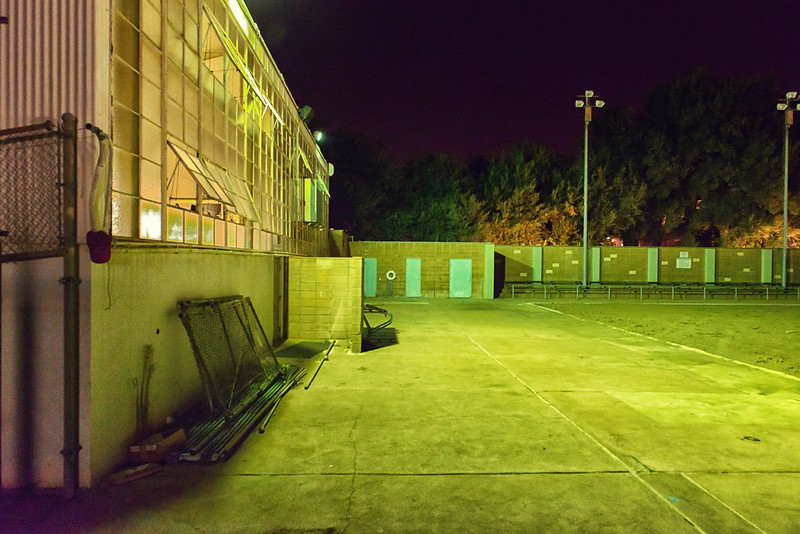
This shot is from a walk with the family the night I got home and opened the new D800. I literally hadn’t taken the time to do anything but put a battery in and put the 24-70 f/2.8 on before running out the door with the family.
The local city college has been undergoing renovations, and this building hasn’t gotten the benefit of those changes. There’s a swimming pool on the left, but it’s been filled in with dirt. The flood lights were off, but the buildings are lit with creepy (sodium vapor?) lights, casting an eerie glow over the scene. I steadied the D800 on a wall and did the best I could to get a reasonably sharp shot at 1/6 sec. at f/5.6 and ISO 6400. I took this version into Nik Color Efex Pro and used Pro Contrast, Detail Extractor and Cross Processing (to enhance the creepy glow to better reflect what the scene looked like to me).
Pipes
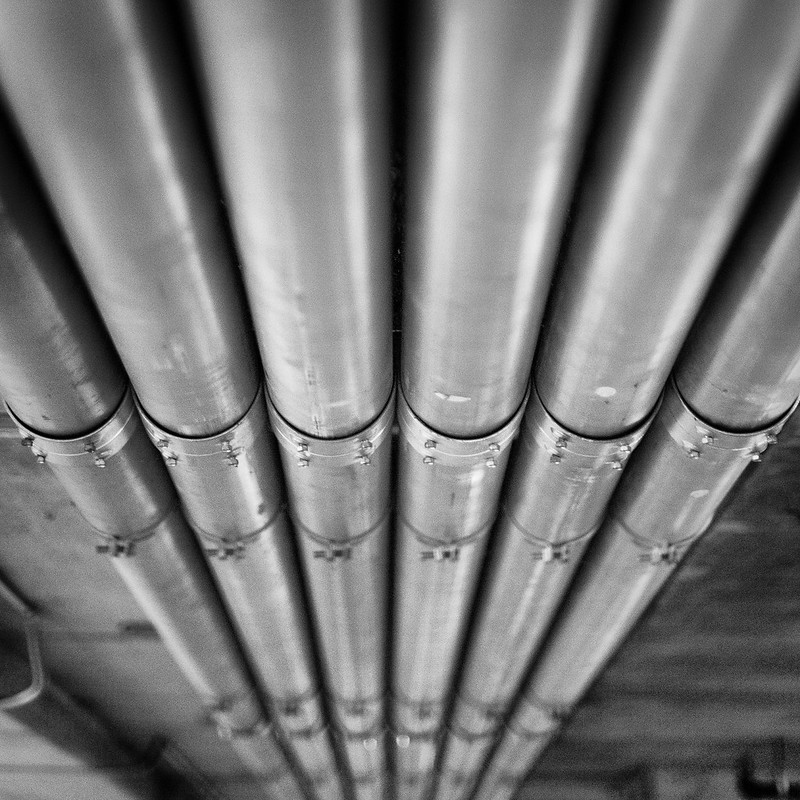
Another shot taken while goofing around with the new camera at work, this time in the parking garage. Also another drastic crop, which still results in a large file. Edited in Silver Efex, and the graininess is from that. Originally shot at ISO 3200, the original’s noise is remarkably low.
Trees in the Parking Lot

I bought a Nikon D800 a couple of weeks ago, and haven’t really had much of a chance to put it through its paces or see what it can really do. So, walking to lunch today with my bag, I saw these trees that are finally exhibiting fall color, and shot some. This is no great work of art or anything, but the detail this camera gets is truly astounding.
I accidentally shot this at ISO 200, despite the obvious abundance of light, mostly because I’m used to ISO 200 being the base of my previous camera, the D700; the D800′s is 100. That said, I couldn’t see any penalty for doing so; the image is noise-free as far as I can tell. In fact, this is a crop of well over half the frame I shot, and it still has more pixels than the full frame of the D700. So far, it’s a very impressive camera.
More to come, obviously.
Sigma Answers, er, Dodges Your Questions About the New Lenses
The only third-party lens I’ve ever bought was a Zeiss. While I know that Sigma, Tamron, and others make some decent lenses, I’ve always perceived the main benefit to buying into Nikon or Canon to be the high-quality glass. Lately, though, I’ve been reading more and more reports about really good Sigma lenses. I’m particularly interested in the recently released Sigma 35mm f/1.4. It’s about half the price of the equivalent Nikkor, which I understand to be good, but not worth the astronomical price it commands.
So, I was interested when FStoppers published the linked “interview” with an unnamed person at Sigma to answer questions about the new lenses and their perceived recent increase in quality. I must say the article pissed me off. It’s clear that Sigma didn’t take the questions seriously, and simply fed marketing and PR copy back as “answers”, which in many cases completely ignore the question at-hand.
For instance, here’s the answer to the question, “Have there been any internal changes in the engineering and development side of Sigma (in terms of talent) that has allowed Sigma to make higher quality lenses?”:
“It is not necessarily new talent, but the Sigma factory in Aizu uses an on-site decision-making team paired with a vertically integrated production system, which allows for a higher degree of communication between the entire team. This self-sustaining communication framework enables feedback to go up and down the production chain easier and promotes innovative product design, production efficiency, and productivity. For more detail please visit Sigma’s Global Vision site.”
What the hell does that word salad even mean?
And for a question I was truly interested in an answer to, “Of the three upcoming lenses, the 35mm is the only without Optical Stabilization. Why?”:
“As a first product from the ‘Art’ line, we put our first priority to achieve the best optical performance among the 35mm F1.4 lens group. We believe that we have executed the mission.”
What does that have to do with the decision to omit image stabilization? Is this person suggesting that the optical performance would have been harmed by the addition of image stabilization?
Stuff like this is really a turn-off.
Sigma Answers, er, Dodges Your Questions About the New Lenses
iPad mini
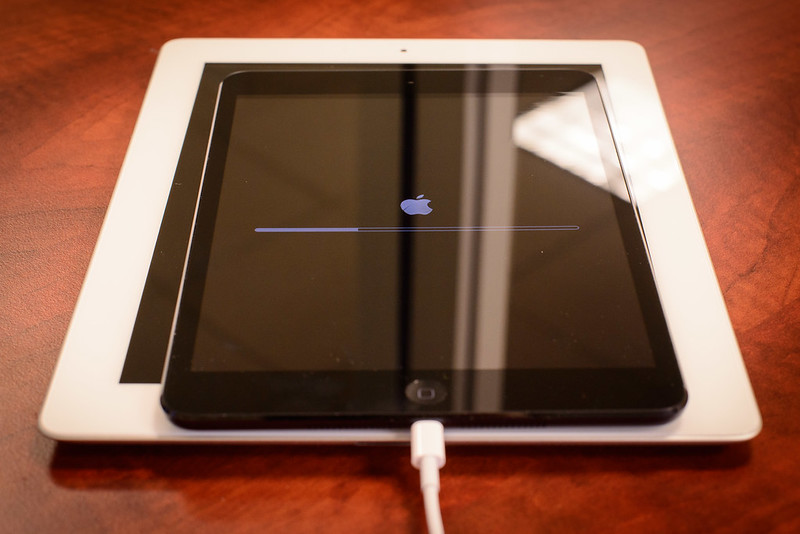
I’ve been using an iPad mini instead of my third-generation iPad for the past few days. I’m no stranger to the seven-ish-inch form factor, having a Nexus 7. I like the size more than I expected to, based on my experience with the full-sized iPad. I’ve frequently wished that my iPad was actually a little bigger, wishing its screen was more of the size of a comic book. Instead, Apple decided to go the other way and make a small one.
The first impression the iPad mini makes is “it’s light”. In fact, after days of use, the light weight is my favorite aspect of it. Sure, the smaller overall dimensions are occassionally nice but, in general, I find that I am better served by the more generously endowed model.
For larger tablets, in terms of aspect ratio, I’m very much in favor of the 4:3 ratio versus the longer 16:9-10 of the competition. In the seven-inch size category, I find this to be less emphatically true, but I still appreciate that Apple stuck with it for the “mini”.

The screen is by far the biggest let-down of the iPad mini. Most reviews I’ve seen have let the mini off the hook far too easily in this regard. Text on the mini is far blurrier than I expected, even in comparison to the Nexus 7, let alone a Retina iPad. The Nexus 7 has marginally higher resolution but, in concert with its slightly smaller size, the sharpness of the Nexus is clearly superior. Additionally, my iPad mini has a blue color cast compared to my iPad 2, third-generation iPad, and the Nexus 7. The iPad mini has been described as a smaller iPad 2, and there’s a lot of truth to that, but I was surprised to find that the mini looked blurrier in practice than my iPad 2. Overall, the screen is the biggest thing holding the iPad mini back (no pun intended).
One bright spot with regards to the screen was reading magazines on it. I thought that the smaller iPad with a low resolution screen would really make the magazine reading experience bad, with complicated layouts that rely on small stylized text. Reading several magazines, including the most recent (and excellently re-implemented) Esquire magazine, was a real pleasure. Comic books were decidedly inferior, especially compared to Comixology’s HD versions, which are presented only on high-resolution devices like a Retina Display. Still, I did enjoy the weight difference when reading for an extended period of time.
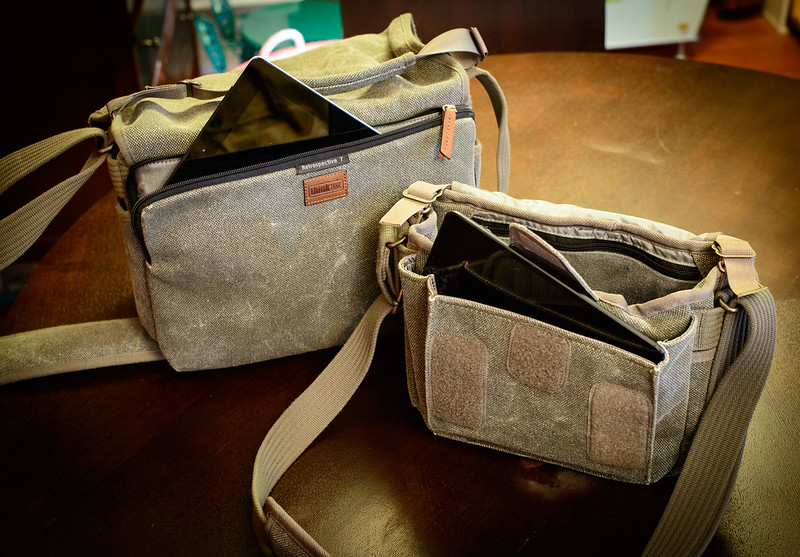
As an aside for those who enjoy photography and the associated gear, when the ThinkTank Retrospective 5 came out, I decided it was (as most photo bags are) almost perfect. I wrote to the company and asked for a Retrospective 6: a bag exactly like the 5, but with just enough extra capacity to carry an iPad. ThinkTank went a little too far and came up instead with the Retrospective 7, which accommodates an iPad or an 11-inch MacBook Air. It’s too big, heavy, and close to the Retrospective 10 for my tastes. The Retrospective 5 can accommodate the iPad mini in its front pocket, making this by far the best reason for me to desire one: it allows me to use my favorite bag I don’t carry. That I own the 5, 7, and 10 tells you how much I love these bags, even though none of them is “just right”.
From the hardware front, the screen is the only thing that favors the Nexus 7, other than the price differential. The apps and iOS itself, as expected, work very well on the mini. The software ecosystem is alone enough reason to own the iPad mini ahead of the Nexus 7, in my opinion, but that gap is narrowing with each release of Android.
So, in summary, the weight of the iPad mini is the star. Once I went back to my full-sized iPad, it was like I’d been wearing clothes that were ever-so-slightly too small and I had been walking around without eyeglasses, where I really could have used them. I found that what I really want isn’t a small iPad (unless it’s to go out with a small photo bag), but a lighter, full-sized iPad.
Postscript
I also have had the chance to use the fourth-generation iPad, albeit in much more limited fashion. I had one on order for myself, but ordered one for testing at work, which arrived first. (Mine hadn’t arrived because it was an LTE model, which don’t ship until later in November.)
Bottom line: it’s faster, but I decided that it wasn’t different enough from the third-generation, and I canceled my order. It would be a great update, a no-brainer really, if you own an iPad 2 or older.

The Making of New York Magazine’s Sandy Cover
Turns out the photographer preconceived and planned the shot. That’s a pro.

More Images From New York’s Sandy Cover
Stunning shots of the city with and without power.
Denver and the Nikon 1 System

I spent a few days on a trip to Denver, Colorado recently, and I took my Nikon V1 kit with me. Walking around downtown with the V1 reminded me how much I really like shooting with it. Having that much hands-on time with the V1 gave me the time to crystallize some of my reactions to the announcement of its successor, the Nikon 1 V2.
I hope the V2 is as good or better in the very important, but extremely subjective feel department. The thing that, above all, makes me like the V1 is its speed of operation: power-on, autofocus, frames-per-second, menu system—they’re all quick. The form factor changes in the V2 do seem to address some popular complaints about the lack of grip and the aforementioned control changes, so I’m optimistic on this front.
My very first reaction when I saw the picture of the V2 was “man, is that ugly”. I know that’s a superficial way to react to a camera, and ultimately much less important than almost any other metric you could judge a camera on, but it’s like they didn’t even try to make it look good. The V1′s looks were polarizing, but I like the V1′s simplicity and low-key, matte black appearance. On the other hand, I was glad to see that the V2 wasn’t another reissue of the V1, similar to what Nikon did with the J2.
So, what did they change and, more importantly, did they implement any of the things I most wanted to see in the V2? So far, and I’ve not had my hands on one, the answer appears to be that they did fix some of the items, but not a lot of them.
The one that jumped out at me immediately was the change to the mode dial. The new mode dial is on the the top deck of the camera, and reportedly is more resistant to accidentally being changed. This was a big weakness in the V1—I can’t count the number of times I brought it to my eye to shoot, only to find myself in some damn not-photo mode. Since I was walking around with the camera in my hand a lot of the time, this happened too frequently past few days and every time it did, I hoped it’s really better in the V2. They added PASM to the mode dial, which is another big win, since one has to go into the menu system to change these basic modes on the V1.
Another change, which gets a lot of attention for the wrong reasons in my opinion, is the new sensor. Most of the reports focus on the increased resolution of the V2′s sensor, while what I really want to know is: Is it as good as the widely acclaimed sensor in the Sony RX100? I guess we’ll have to wait until the camera is generally available to find out.
What about the rest? GPS? Goddammit, no. I don’t want that stupid accessory on top of the camera! Especially on the top of the heinous bulb that was added to the viewfinder to support the flash I wish you hadn’t added. Grrr.
Speaking of flash, there’s a new Speedlight unit coming out at the same time as the V2, but I’m not sure what it brings to the party that the neat little SB-N5 doesn’t. The new model requires its own batteries, and while I guess that’s OK since the V1′s battery life is pretty abysmal, I rather like that I don’t have to worry about checking the battery in the flash. It doesn’t seem like they added what I’d consider to be the most desirable feature: a Commander mode that can trigger other Nikon Speedlights. I know I’m in the minority, but I’ve used the SB-N5 for no other reason than to trigger off-camera flashes via slave, and it would be great if they’d have made the new unit a Commander, so the system could do TTL with remote flashes like the big brother cameras can.
Adding to the battery note, another change I’m mixed on is that they changed the type of battery the V2 from the V1′s. As I said, I’m not a fan of the V1′s battery life. I have two batteries for the V1. I left for four days and figured that 2 batteries would be enough (hell, my D700 almost seems like it never needs to be charged, let alone go to the fallback battery), so I didn’t pack the charger. They were enough, but barely; the second battery died just as I was getting ready to head home. So why am I mixed on the change, other than I already have 2 of the old ones? Well, I did like that Nikon was using the same battery in the V1, the D800, and the D7000. I’ll have more to say about this soon, but I have a D800 on its way to me, and I’m looking forward to having a few batteries that can be used on either camera. Since I don’t have a V2, I still will, but that’s a minor negative nonetheless.
Back to the camera body: what about my other wishes? How about integrated VR? No, but I didn’t really expect that they would. Nikon is invested in lens-based VR, even though they’re not putting it in the anything except the slow-ass zooms. At least there are some signs of life from Nikon on the lens front, with some fast primes coming out in the near future.

Along those lines, walking around and shooting, the biggest bummer is the lack of fast glass, especially in concert with the low shutter speed/Auto ISO problem. It’s a real drag to compose a scene only to find that I have to mess with the ISO because the slow zoom is at f/5-something and the camera has allowed the shutter speed to go to 1/15 instead of raising the ISO to a reasonable, available level. I managed to have a packing failure that left me without the 10mm f/2.8, which would probably have been on the camera a lot if I’d remembered it. (While we’re at the fast prime thing, how about a 10mm that’s at least f/1.4? Hell, bring on the f/1.0-1.2!)
I did manage to pack the FT-1 adapter and my F-mount 50mm f/1.4. That combo saw quite a lot of use, and since that’s essentially a cheap, small, blazingly fast 135mm on the V1, it was a go-to combo for low light. Here’s another place where I wish for the VR, though. This effective focal length really exacerbates the above complaint about shutter speed. In any case, I’m really hoping that Nikon has changed this behavior. While I’m on about the FT-1, I’m also hoping (although haven’t found an evidence that this is the case) that the V2 will allow AF-C mode and perhaps allow other focusing modes that the center point. (I almost always have the camera set to center point focusing anyway, but I was using that combo indoors at a convention, and being able to have the focus track the speaker’s face would have been welcome.)
I’ll have to wait to find out if they’ve fixed some of the other niggles I have with the V1. There’s a bunch of wishes I have for the Auto ISO mode: a sane way to set minimum shutter speeds in Auto ISO; adding Auto ISO 1600; showing the actual current ISO in the viewfinder instead of the current maximum that’s set. I’d also like there to be a histogram available while shooting. I’d love for the back LCD to show the image review as I’m shooting and leaving the EVF focused on the scene. I don’t think any of these things are in the V2, but we’ll see.
So, am I going to buy one? No, not yet. I’m interested, but if some of those items I’ve listed above aren’t fixed, I can’t bring myself to spend a bunch of money supporting Nikon’s endeavors here. In fact, I’m considering canceling my pre-order of the new lenses until I get some hands-on with the V2. If the V2 is a big disappointment, I may get out of the Nikon 1 system despite how much I like shooting with it now. The competition is just too stiff to keep investing in a system from a company that isn’t listening like Sony, Olympus, Panasonic, and Fuji appear to be. I just don’t need the things they seem to be more focused on, like the best shot selector and other gimmicky modes.

Election Day Problems, Long Lines and Confusion
Thankfully, there were no problems like this where I live. This is a disgrace, and fixing these issues should be among the highest priorities in a country that defines itself by its democracy.
Problems at the Polls
As they stand in hourlong lines to cast a ballot, voters might ask themselves, why isn’t the government making it easier for me to vote, rather than forcing me through an endurance contest?
No One in America Should Have to Wait 7 Hours to Vote
New York Magazine’s Cover Photo of Sandy

Twin Photographs
Neat story.